
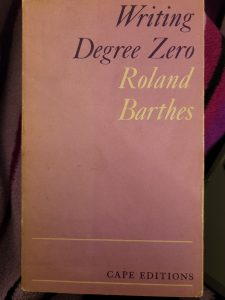
4099 - Writing Degree Zero
Author: Roland Barthes
Description: This landmark 1953 essay-collection marks Barthes’s entry into literary criticism. It interrogates whether “neutral” writing—free from overt style and political pretense—is possible. Over four essays and an introduction, Barthes distinguishes between language, style, and writing, and critiques the self-conscious, ideologically laden prose of mid‑20th-century French literature. He champions a transparent, “zero-degree” writing that resists empty conventionality and allows truth to emerge unmediated . ⸻ Keywords: writing theory, literary criticism, form vs. style, neutral prose, structuralism, French literature, Roland Barthes, ideology in writing ⸻ Ideal for: Students and scholars of literary theory, structuralism, semiotics, and anyone interested in the politics of form and language. ⸻ Age: 18 years and up (academic and theoretical content suited for mature readers) ⸻ Theme: The tension between language and politics, clarity versus convention, the possibility of writing beyond style, writing as ethical action ⸻ Tone: Analytical, rigorous, uncompromising, intellectually provocative, and occasionally poetic . ⸻ Book Type: Literary‑critical manifesto; structuralist theory; essays on writing and society ⸻ Length: Approximately 112 pages.